
Morse Code Translator Online
You found a string of dots and dashes somewhere and have no idea what they mean. Or you need to convert a message into Morse code right now and do not have time to sit down with a chart. Maybe you are a student working on a project, or someone who just wants to hear what their name sounds like in real Morse audio. Whatever brought you here, the answer is the same: you need a fast, accurate, free Morse code translator website that works without downloading anything, creating an account, or wading through ads.
This free Morse code translator does exactly that. Type English and get Morse code. Paste Morse code and get English back. Hit Play and hear it out loud. Turn on light mode and watch it flash. Download the audio as an MP3.
Why Choose This Morse Code Translator
Getting your first translation takes under 30 seconds. Here is the full step-by-step process:
Type or Paste
- Type English text directly into the left input box for text-to-Morse conversion.
- Paste Morse code (dots and dashes) into the right box to decode it into English.
- The tool detects what you entered and translates automatically, no button press needed.
Save, Copy, or Share in One Click
- Click Copy under either box to grab the text or Morse output for use elsewhere.
- Click MP3 to download the audio file.
- Click Share to generate a shareable link with your message and settings included.
Switch Directions Anytime
- Use the swap arrow button between the two boxes to reverse the translation direction.
- Switch from encoding to decoding mid-session without clearing your input.
Play Your Translation Out Loud
- Press the Play button under the Morse output to hear the audio.
- Use Stop to pause and Repeat to loop the message for practice.
- Adjust volume before playing if needed.
Set Your Speed Before You Practice
- Click Configure before pressing Play
- Set WPM to 5 or lower if you are a beginner.
- Set Farnsworth spacing lower than your WPM to give your brain time between characters.
- Choose CW Radio Tone for clean modern beeps or Telegraph Sounder for the classic sound.
Morse Code: What It Actually Is and How It Works
Most people know Morse code involves dots and dashes. Very few people know how it actually functions as a system. Understanding the logic behind Morse code makes it dramatically easier to use, learn, and remember.
Two Signals, Infinite Messages
The entire Morse code system is built on exactly two signals. A short signal called a dot and a longer signal called a dash. That is it. Every letter in the alphabet, every number from zero to nine, every punctuation mark, and every procedural signal used in radio communication is a unique combination of those two elements. The simplicity is not a limitation. It is the reason Morse code can be transmitted by sound, by light, by vibration, by tapping on a surface, or by blinking. Any medium capable of producing two distinct states can carry a Morse message.
Where It Came From
Samuel Morse and Alfred Vail developed the first working version of this system in the 1830s. In 1844, Morse sent the first long-distance telegraph message in history: “What hath God wrought?”, a phrase chosen by Morse himself from the book of Numbers. Within the next few decades, telegraph lines crossed continents and then oceans. Morse code became the dominant communication technology for military, maritime, and commercial use worldwide. The international standard was formalized by the ITU (International Telecommunication Union) and has remained largely unchanged since the late 1800s.
What Exactly Does This Tool Do
This is not a basic text converter that outputs dots and dashes and leaves you alone. It is a complete Morse code system built for translation, learning, and practice. Here is every feature and what it actually does.
English to Morse Code Translator
Type any word, sentence, or phrase into the input box, and the Morse code appears instantly. The tool supports all 26 letters of the alphabet, numbers 0 through 9, and common punctuation marks, including periods, commas, question marks, and more. There is no delay, no submit button, and no character limit that will stop you mid-message.
Morse Code Translator to English
Got dots and dashes you need to decode? Paste them directly into the input. The tool reads the spacing and converts the Morse code to English automatically. Use a single space between each letter and a forward slash between words. This translates Morse code to English feature works in real time as well, so you see the decoded output the moment you finish typing.
Light Signal Output
Switch on Light Mode, and your message plays back as a blinking light signal instead of, or alongside, the audio. Short flashes represent dots. Long flashes represent dashes. The timing stays perfectly synced. This mirrors how Morse was actually sent through lamps and signal mirrors historically, and it gives visual learners a completely different way to internalize the rhythm.
Speed and Sound Configuration
Click Configure, and a full settings panel opens. You can control WPM (words per minute), Farnsworth spacing, pitch in Hz, and volume. You can also switch the sound type between a telegraph sounder and a CW radio tone. The telegraph sounder gives you the classic clicky mechanical sound. The CW radio tone gives you the clean beep used in modern amateur radio. Both are authentic.
Download as MP3
Once your translation is ready and the audio sounds right, hit the MP3 button and download the file. You can take it offline, load it onto your phone, use it for radio training, or replay it somewhere without internet access. No conversion tools needed.
Copy, Share, and Random Input
Each input and output box has a one-click copy button. The Share button generates a link with your translation pre-loaded so someone else can open it and hear exactly what you sent. The Random button generates a sample message for practice. If you are trying to test your decoding skills, hit Random, press Play, close your eyes, and try to identify the letters before looking.
Who Uses a Morse Code Translator and Why
People land on this page from very different starting points. Understanding where you sit in that list helps you get the most out of the tool.
The Curious Beginner
You saw dots and dashes somewhere. In a film, carved into something, printed on a piece of jewelry, or hidden in a game level.
The Student and Hobbyist
You are learning Morse code for fun, for a Scout certification, for a school project, or simply because it is an interesting challenge.
The HAM Radio Operator
Licensed amateur radio operators use CW (continuous wave Morse) because it travels farther with less transmission power than voice communication.
The Gamer and Puzzle Solver
Escape rooms, ARGs (alternate reality games), and video games hide Morse code in audio tracks, background visuals, loading screens, and in-world objects.
The Person Using It for Personal Meaning
You want to translate a name, a date, a phrase, or a sentence for a tattoo, a custom necklace, a personalized gift, or a card.
The Accessibility User
Morse code is a two-signal system. That means it can be operated with the most minimal physical input imaginable: a single button, a blink, a slight finger movement. Google’s Gboard keyboard for Android includes a dedicated Morse input mode.
The Survival and Preparedness Minded
When phones have no signal, the internet is unavailable, and voice communication is not an option, Morse code still works. Any repeatable short-long signal carries a message. A flashlight, a whistle, two rocks, and a vehicle horn. Knowing SOS is the minimum.
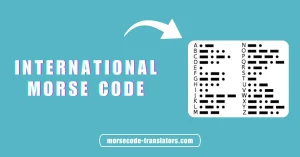
International Morse Code vs. American Morse Code
Two versions of Morse code exist. Most people have never heard of the second one.
Feature | International Morse (ITU) | American Morse |
Governing body | ITU: global standard | Historical US railroad system |
Timing rules | Consistent and fixed | Variable, letter-dependent |
Used today | Yes: aviation, HAM, maritime, emergency | Rarely; historical study only |
Supported by online tools | Every modern translator | Legacy tools only |
American Morse was the original version developed by Samuel Morse for US telegraph lines. It had inconsistent spacing rules and was harder to learn. International Morse replaced it as the global standard and simplified everything into a fixed timing system.
Why Morse Code Still Works
Modern communication depends on infrastructure. Phones need cell towers. The internet needs servers. Even most radio communication needs functioning equipment on both ends. Morse code needs almost nothing. A working transmitter and a receiver. Or a flashlight and a set of eyes. Or two objects you can tap together.
During power outages, natural disasters, extreme interference conditions, and emergencies where digital systems fail, Morse code still carries messages. That is why the ITU kept it in the international distress framework and why military and maritime organizations still train with it today.
The ITU Morse alphabet was not designed randomly. It was engineered so that the most commonly used letters in English have the shortest codes. E is a single dot. It is a single dash. Those two letters appear more frequently in English text than any others, so giving them the simplest codes keeps transmission fast and efficient.
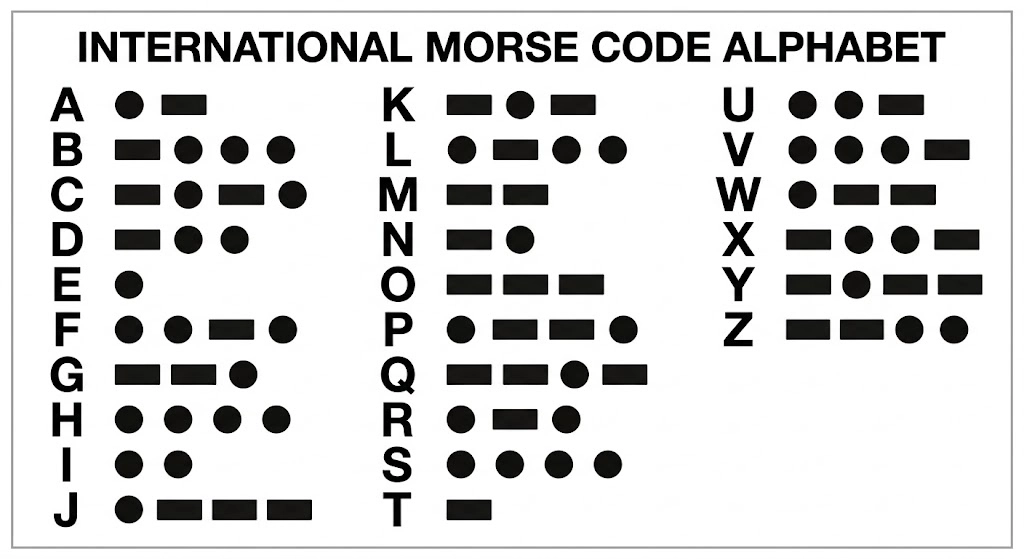
Letter | Morse Code | Spoken Rhythm |
A | · — | di-DAH |
B | — · · · | DAH-di-di-dit |
C | — · — · | DAH-di-DAH-dit |
D | — · · | DAH-di-dit |
E | · | dit |
F | · · — · | di-di-DAH-dit |
G | — — · | DAH-DAH-dit |
H | · · · · | di-di-di-dit |
I | · · | di-dit |
J | · — — — | di-DAH-DAH-DAH |
K | — · — | DAH-di-DAH |
L | · — · · | di-DAH-di-dit |
M | — — | DAH-DAH |
N | — · | DAH-dit |
O | — — — | DAH-DAH-DAH |
P | · — — · | di-DAH-DAH-dit |
Q | — — · — | DAH-DAH-di-DAH |
R | · — · | di-DAH-dit |
S | · · · | di-di-dit |
T | — | DAH |
U | · · — | di-di-DAH |
V | · · · — | di-di-di-DAH |
W | · — — | di-DAH-DAH |
X | — · · — | DAH-di-di-DAH |
Y | — · — — | DAH-di-DAH-DAH |
Z | — — · · | DAH-DAH-di-dit |
Do not try to memorize this table by reading it. Use the audio playback feature above, type each letter, press Play, and listen to the rhythm. The spoken rhythm column is what actually sticks in memory. Your ears will hold onto “di-DAH” for A far longer time than your eyes will hold onto “· —” on a page.
You can find the full detailed Morse Code Alphabet guide here for a deeper breakdown of every letter with memory tricks and pattern groups.
Mirror Letter Pairs
Some letters are exact reversals of each other. Learning one side of each pair gives you both letters for the price of one.
Pair | Letter | Code |
1 | E | · |
T | — | |
2 | A | · — |
N | — · | |
3 | U | · · — |
D | — · · | |
4 | K | — · — |
R | · — · | |
5 | V | · · · — |
B | — · · · |
Learn A, and you know N. Learn U and you know D. Five pairs give you ten letters. That is over a third of the alphabet handled with half the effort.
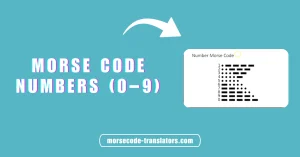
Numbers are the most logical part of the entire Morse system. Once you understand the pattern, you will never need to look at a chart again. This Morse code translator helps you translate Morse code numbers in just seconds.
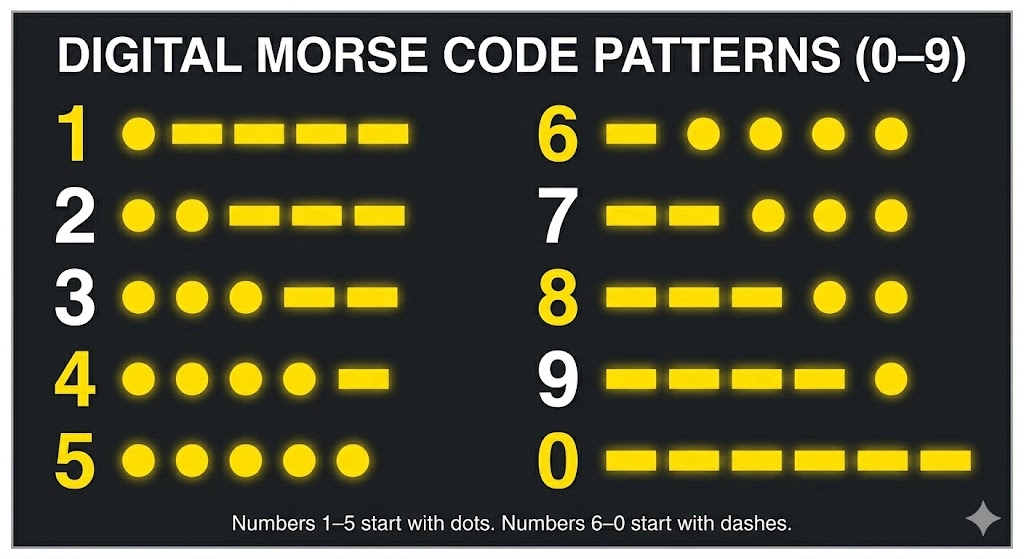
Number | Morse Code | Pattern Logic |
1 | · — — — — | 1 dot, 4 dashes |
2 | · · — — — | 2 dots, 3 dashes |
3 | · · · — — | 3 dots, 2 dashes |
4 | · · · · — | 4 dots, 1 dash |
5 | · · · · · | 5 dots — all short |
6 | — · · · · | 1 dash, 4 dots |
7 | — — · · · | 2 dashes, 3 dots |
8 | — — — · · | 3 dashes, 2 dots |
9 | — — — — · | 4 dashes, 1 dot |
0 | — — — — — | 5 dashes — all long |
The rule: numbers 1 through 5 start with dots. Each step up adds one more dot and removes one dash. Number 5 is all dots. Then the pattern flips. Numbers 6 through 9 start with dashes, adding one more dash with each step. Zero is five dashes, the complete opposite of five. Learn that rule, and you already know all ten digits without memorizing a single line of the table.
For a deeper breakdown of the number system and how it connects to the full code structure, visit the Morse Code Numbers page.
Punctuation in Morse Code
Punctuation codes are longer than letter codes, using six signals each. This is intentional: longer codes are harder to confuse with shorter letter codes during transmission, which reduces errors.
Symbol | Name | Morse Code |
. | Period | · — · — · — |
, | Comma | — — · · — — |
? | Question Mark | · · — — · · |
! | Exclamation | — · — · — — |
/ | Slash | — · · — · |
( ) | Parentheses | — · — — · — |
@ | At Sign | · — — · — · |
‘ | Apostrophe | · — — — — · |
: | Colon | — — — · · · |
; | Semicolon | — · — · — · |
– | Hyphen | — · · · · — |
= | Equals | — · · · — |
Start with the period, comma, and question mark. Those three cover the vast majority of punctuation you will use in any real message. The others are worth learning once you are comfortable with the full alphabet and number set.
Related Blogs
Prosigns: The Signals That Control Conversations
Prosigns are procedural signals that control how radio transmissions flow. They are not letters, and they do not appear in standard Morse alphabet charts. Most beginner guides skip them entirely, which is a gap worth filling because real radio communication uses them constantly.
A prosign is sent as one continuous, unbroken character. There are no letter gaps within it. The table below covers the eight prosigns every operator knows.
Prosign | Meaning | When It Is Used |
AR | End of message | Signals the transmission is complete |
SK | End of contact | Final sign-off at the end of a conversation |
BT | New paragraph or break | Separates sections in a long message |
KN | Go ahead, specific station | Invites one specific station to respond |
K | Go ahead, any station | Open invitation for any station to reply |
AS | Wait or stand by | Asks the other operator to pause |
SOS | Emergency distress | International emergency call |
CQ | Calling all stations | General call to any available operator |
If you ever connect with a real HAM radio operator or explore amateur radio communities, you will hear these. Not knowing them is like knowing a language’s vocabulary but not its grammar.
Q-Codes: How Radio Operators Compress Full Sentences
Q-codes are three-letter abbreviations that each replace an entire sentence. They were developed in the early 20th century to speed up communication between operators, especially across language barriers. A single three-letter burst carries the same information that would otherwise take ten words.
Q-Code | Full Meaning | Example Use |
QTH | What is your location? / My location is… | QTH = London |
QRM | Interference from other stations | QRM = I am getting interference |
QRN | Static or atmospheric noise | QRN = Heavy static on this frequency |
QRQ | Please send faster | QRQ = Increase your speed |
QRS | Please send slower | QRS = Slow down, I cannot keep up |
QRZ | Who is calling me? | QRZ = Identify yourself |
QSL | I confirm receipt | QSL = Message received and understood |
QSO | Communication with another station | QSO = I am in contact with… |
QSY | Change to a different frequency | QSY = Move to another channel |
QRX | Stand by | QRX = Please wait |
These ten Q-codes cover the core of practical Morse communication between operators. QSL and QRS alone appear in almost every beginner radio exchange. Learn these alongside the alphabet, and you move from a person who can decode letters to a person who can actually communicate.
Most Morse code learning advice is the same list of methods repeated in a different order. Here are the real tips you can follow, and learn Morse code.
The Mistake Almost Everyone Makes
Reading a dot-dash chart and trying to memorize it visually. It works for the first ten letters. Then it stalls completely. The patterns start blending together on the page, and the brain has no reliable way to distinguish them. Professional operators did not learn this way, and neither should you.
The Mirror Pair Method
Refer back to the mirror pairs table in the alphabet section above. Learn A and N together because one is the reverse of the other. Learn U and D together for the same reason. Five pairs equals ten letters. You reduce your learning load by half, and the contrast between paired letters makes both of them easier to remember than either would be alone.
The One Setting That Transforms Beginner Practice: Farnsworth Speed
Most people open the translator, hit Play at default settings, hear nothing intelligible, and give up. The missing step is Farnsworth. Set your character’s WPM to 15 or 20. Set your Farnsworth WPM to 5 or 6. You will hear each character played at real Morse rhythm, with generous space between characters to process what you just heard. This single configuration change is the difference between practice that builds skill and practice that builds frustration.
Learn by Sound From Day One
Type a single letter into the translator. Press Play. Close your eyes. Listen to the rhythm. Repeat it out loud using the spoken name: “di-DAH” for A, “DAH-dit” for N, “di-di-dit” for S. Say it back five times. Then move to the next letter. The spoken rhythm is what is held in memory because your brain processes sound patterns differently from visual symbols. Sounds attach to meaning faster, stay longer, and transfer to real listening practice directly.
Start With These 6 Letters Only
E, T, A, N, S, O. Stop there and learn only these six first.
These are the six most frequently occurring letters in English text. They also have the six shortest Morse codes in the entire system. Knowing these six gives you the ability to decode a large percentage of common short words before you have touched the rest of the alphabet. Starting with the full 26 letters simultaneously is the second biggest mistake beginners make.
The 10-Minute Daily Rule
Week | Focus | Goal by the End of the Week |
1 | E, T, A, N, S, O | Decode HI, NO, SO, AN, ONE, TEN by ear |
2 | R, D, I, M, K, W | Decode WORK, MIND, DARK, SWIM by ear |
3 | SOS, OK, YES, NO as full words | Decode all without looking at the output |
4 | Random messages from the tool | Decode 5-word messages cleanly |
Ten minutes every day produces better results than one hour every weekend. Morse code is a motor and auditory memory skill. It consolidates during rest. Short daily sessions give your brain time to absorb what it practiced before the next session adds more.
Morse Code Timing
Timing is the most important and least discussed part of Morse code. Very few people explain that the spaces between them carry just as much information as the signals themselves. Get the timing wrong, and a perfectly correct sequence of dots and dashes becomes unreadable noise.
The Five Timing Rules
Everything in Morse timing is measured in units. One unit equals the length of one dot. That is the foundation. Every other timing measurement is a multiple of it.
Element | Duration | What It Means |
Dot | 1 unit | Short signal |
Dash | 3 units | Long signal — three times a dot |
Gap within a letter | 1 unit | Pause between signals in the same character |
Gap between letters | 3 units | Pause separating two different characters |
Gap between words | 7 units | Pause separating two different words |
Change your dot length, and everything else adjusts proportionally. A faster operator has a shorter dot. A slower operator has a longer one. But the 1:3:7 ratio stays fixed no matter the speed.
What WPM Actually Measures
WPM stands for words per minute. The benchmark word used to measure Morse speed is “PARIS.” That specific word was chosen because it contains exactly 50 timing units, which makes it a consistent and reproducible measuring stick across all operators and tools.
Level | WPM | Who It Is For |
Beginner | 3 to 5 | First-time learners |
Casual | 5 to 10 | Students and hobbyists |
Intermediate | 10 to 15 | Regular practice users |
Skilled | 15 to 20 | HAM radio operators |
Advanced | 20 to 30 | Experienced CW users |
Expert | 30 and above | Competition-level operators |
Start at 5 WPM if you are new. It feels slow, but slow and correct builds better muscle memory than fast and sloppy.
Farnsworth Speed
Farnsworth speed is a training technique, not a separate standard. It works like this: characters are sent at your target speed (say, 15 WPM), but the spacing between them is stretched out to a much slower effective rate (say, 5 WPM). Your brain hears each character at the correct real-world rhythm, but gets extra time between characters to process what it just heard.
This matters because of a common beginner trap. If you learn Morse at 5 WPM across the board, you learn the slow Morse code translator sound of each letter. When you later try to speed up, the sounds are wrong because the rhythm is different at higher speeds. Farnsworth prevents that. You learn the real sound from day one. The best starter settings are 15 to 20 WPM character speed, 5 to 8 WPM Farnsworth speed, and a pitch between 550 and 600 Hz.
The Timing Mistakes That Confuse Every Beginner
Mistake | Why It Happens | How to Fix It |
Dashes sound too short | Sending dashes at 2x instead of 3x dot length | Use audio playback and compare your dash to the reference |
Letters running together | Not leaving enough gap between characters | Pause and consciously count three units between each letter |
Words blending into each other | Using a 3-unit gap instead of a 7-unit gap between words | Exaggerate the word pause until the habit forms naturally |
Speed keeps changing | Rushing easy letters and slowing on hard ones | Practice the difficult letters separately at a higher speed |
Farnsworth not helping | Character speed and Farnsworth set to the same number | Always keep Farnsworth WPM lower than character WPM |
The Most Searched Morse Code Phrases
Some Morse phrases get searched thousands of times a day, not because people are learning to operate radios but because they want to know what a tattoo says, decode something from a game, or understand a message they found somewhere unexpected. Here are the most common ones with full translations and context.
· · — — — · · ·
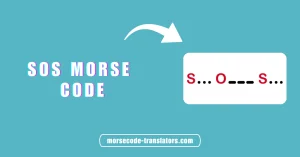
Three dots. Three dashes. Three dots. That is it. The simplest emergency signal in human history.
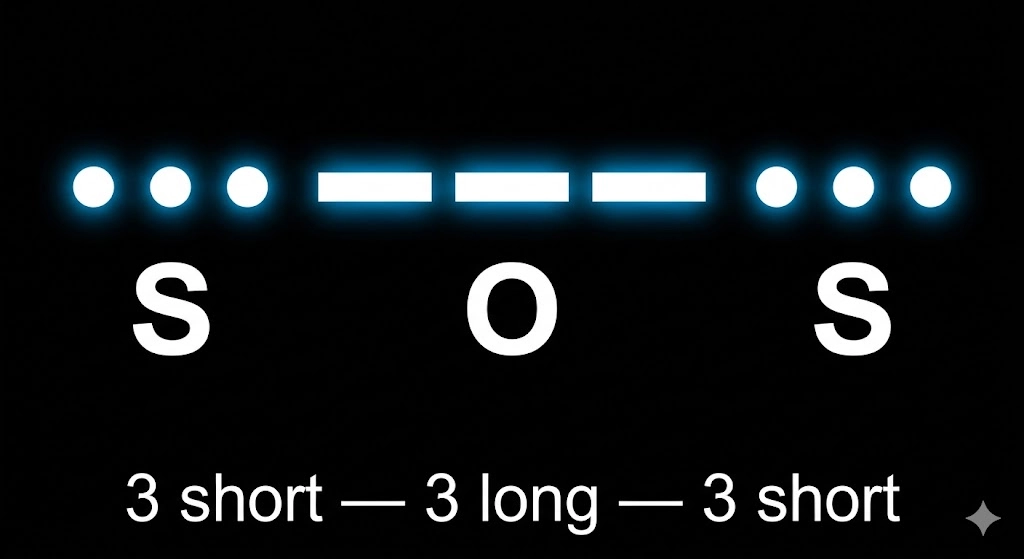
SOS was not chosen because it stands for anything. It was chosen because the pattern is impossible to confuse with any other Morse signal. No other common combination of three letters produces that rhythm. In 1912, the Titanic operators transmitted this signal, and a nearby vessel received it, leading to the rescue of over 700 people. Decades later, a hiker in Alaska with a failed radio used a flashlight to signal SOS to a passing aircraft. The pilot recognized the pattern and called for rescue. The signal still works the same way today.
Read the full breakdown on the SOS in Morse Code page.
Hello in Morse Code
· · · / · / · — · · / · — · · / — — —
Hello is one of the best first practice words. It has five different letters, each with a distinct pattern, and your brain already knows the word, so you can verify your decoding immediately. Type it into the translator above and press Play to hear how it sounds as real audio.
I Love You in Morse Code
· / · — · · / — — — / · · · — · / · — · · · ·
This is one of the most searched Morse phrases online, and most of the people searching it are not radio operators. They want to use it in a tattoo, encode it in jewelry, put it in a birthday message, or send it to someone who will have to decode it first. The pattern is complex enough to look impressive and meaningful enough to matter. Get the full guide on the I Love You in Morse Code page.
Help and Help Me in Morse Code
Help: · · · · / · / · — · · / · — · · ·
Help Me: · · · · / · / · — · · / · — · · · / — — / ·
Knowing HELP in Morse is a practical skill, not just a curiosity. If your voice is not an option due to injury, noise, distance, or danger, any surface you can tap and any light you can flash becomes a communication device. Read the complete guide on Help Me in Morse Code with more context on emergency use.
Common Phrases Quick Reference Table
Phrase | Morse Code | Context |
SOS | · · · — — — · · · | Universal distress signal |
Hi | · · · · / · · | Shortest greeting: 6 total signals |
Yes | — · — / · · · | Radio confirmation |
No | — · / — — — | Radio refusal |
OK | — — — / — · — | Acknowledgment or agreement |
Sorry | · · · / — — — / · · · / — · | Personal messages |
Love | · — · · / — — — / · · · — · / · | Gifts, tattoos, personal use |
Good Morning | — — · / — — — / — — — / — · · / — — / — — — / · — · / — · / · · / — · / — — · / — | Daily greeting |
You will find detailed individual guides for Morse Code Words, including these and many more, on the words reference page.
Morse Code Across Different Languages
Most people assume Morse code is only for English. The ITU international standard covers far more than that.
Arabic, Cyrillic, and Other Adapted Systems
Language or System | Coverage |
International ITU | Standard A–Z, 0–9, punctuation — global standard |
Accented Latin | é, ü, ñ, ö, à and other European language characters |
Arabic Morse | Full Arabic alphabet encoded in dot-dash patterns |
Russian Cyrillic | Russian and other Slavic language alphabets |
Greek Morse | Full Greek alphabet in Morse format |
Hebrew Morse | Hebrew alphabet in dot-dash encoding |
Korean Hangul | Hangul characters adapted to Morse timing |
Every one of these systems uses the same dot and dash signals and the same timing rules. The only difference is which characters those signals represent. This is why Morse code functions across language barriers in a way that very few other communication systems can match.
For a deep dive into how different language systems connect to the international standard, visit the International Morse Code reference page.
Japanese Wabun Code
The Wabun code was developed in the early 20th century, specifically for Japanese katakana characters. It maps each katakana syllable to a unique dot-dash pattern using the same timing structure as international Morse. Japanese radio operators used it extensively through the mid-20th century, and it is still studied today by Morse enthusiasts and amateur radio operators in Japan. It is a strong example of how the Morse framework adapts to entirely different writing systems without changing its fundamental logic.
The ITU Extended Alphabet
The international standard includes accented characters from European languages, each with its own code. É (used in French and Spanish) is · · — · ·. Ñ (Spanish) is — — · — —. Ü (German) is · · — —. Ö (German and Swedish) is — — — ·. These follow exactly the same timing rules as standard letters. Only the character-to-code mapping changes. A Morse code translator online that supports the full ITU character set handles all of these without any special input method.
The Science Behind Why Morse Code Sticks in Your Brain
Most people who try to learn Morse code from a chart give up within a week. Most people who learn it through audio are still using it months later. That gap is not about effort or intelligence. It is about how the human brain actually stores and retrieves patterns.
When you look at a dot-dash chart and try to memorize that · — is A. Your brain files that as a visual symbol. They fade quickly because the brain has no strong reason to prioritize them over anything else it is storing.
When you hear “di-DAH” for the letter A, something different happens. Rhythmic patterns processed in the brain get linked to what neuroscientists call procedural memory. Procedural memory does not fade the way declarative memory (facts, symbols, lists) does. Once it is built, it is extremely durable.
This is why Morse code translater audio tools are not just a convenience feature. They are the neurologically correct learning method. The audio is not supplementary. It is the actual mechanism by which Morse code gets stored in long-term memory.
Translate Morse Code From an Image or Picture
People searching for a Morse code translator image or a Morse code translator picture are usually holding a phone photo of something, a screenshot of a game, a photo of an engraving, a screenshot of a social media post, or an image of handwritten dots and dashes. The question is always the same: how do I get this into readable text?
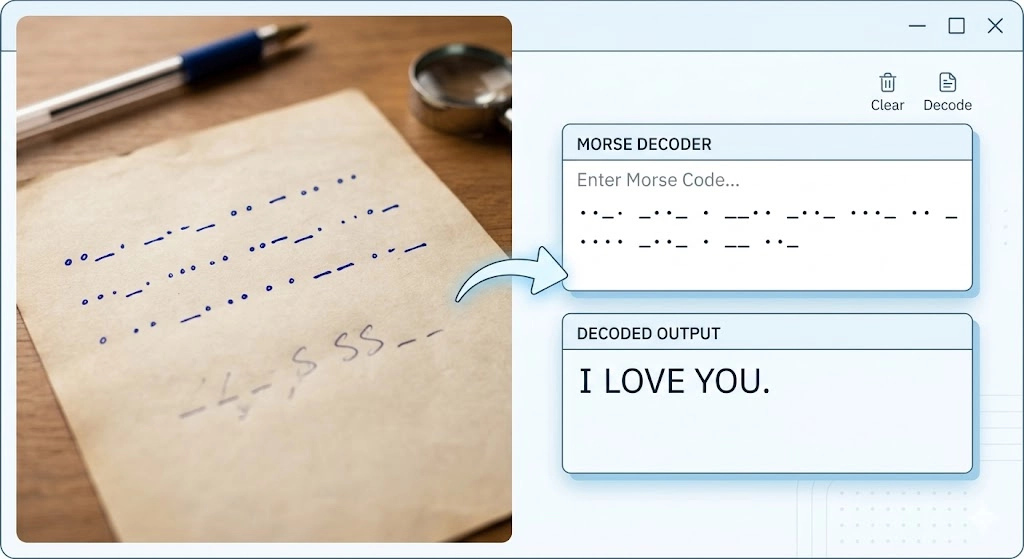
Optical character recognition was built for standard fonts. Morse code dots and dashes vary too much in size, shape, spacing, and rendering style depending on whether they were handwritten, engraved, photographed, or printed. Automated image reading produces frequent errors. Manual reading into this translator remains the most accurate approach by a wide margin.
Here is the step-by-step process:
- Look at the image from left to right and identify each individual signal.
- Classify each signal as a dot (short) or a dash (long) based on its relative lengths.
- Look for gaps between signals within the same letter; these are short.
- Look for longer gaps between separate letters; these are visibly wider.
- Identify even longer gaps or slashes that mark the boundary between words.
- Type what you read using a period for dots, a hyphen for dashes, a space between letters, and a forward slash between words.
- Paste it into the translator, and the English output appears.
The most common challenge is blurry or low-quality images, where all the signals look the same length. In that case, use context: most Morse letters use a mix of dots and dashes, so if everything looks identical, the image quality or the angle is distorting the lengths. Try adjusting the image contrast or brightness before reading it.
For handwritten Morse, signal lengths are the least consistent. When you are unsure whether a signal is a dot or a dash, try both interpretations in the translator and see which produces a recognizable word.
Error Detection in Morse Code: What to Do When a Signal Goes Wrong
Morse code works in real conditions, not just clean practice sessions. Static, weak signals, and rushed sending all introduce errors. Here is what to do when something goes wrong:
Single-signal errors are the most common
A dash sent slightly too short becomes a dot. A dropped dot turns D into N. When a decoded word looks wrong, check the most confusion-prone pairs first: E/T, S/O, D/N, U/V, and K/C.
Use word context before asking for a retransmission
If one letter in a decoded word looks off, read the full word first. “H_LLO” is HELLO. Context fills single-letter gaps faster than requesting a repeat signal does.
Watch your timing before blaming interference
Most errors come from inconsistent sending, not bad conditions. A dash at 2.5 units instead of 3 is enough to flip one letter into another. Fix your timing consistency first.
Send QRS if the incoming signal is too fast to decode cleanly
QRS tells the other operator to slow down. Do not guess at corrupted letters under speed pressure. One clean, slow message beats three fast corrupted ones.
Send QRM or QRN to flag interference
QRM signals manmade interference from other transmitters. QRN signals atmospheric static. Naming the problem tells the other operator what kind of retransmission strategy to use.
For heavily corrupted messages, ask for the prosign BT and a repeat
BT signals a paragraph break and restart. A partial repeat from the last clean word is faster and more reliable than a full message retransmission.
Conclusion
Morse code is not just for fun. It is a living system used every day by HAM radio operators, pilots, military personnel, accessibility technology users, puzzle designers, and people who simply want to say something in a way that requires a little decoding. The Morse code translator on this page handles all of it: text to Morse, Morse to English, real audio, light signals, full speed control, MP3 download, and support for the complete international character set, including numbers, punctuation, prosigns, and extended language characters.
Type something in. Press Play. Hear what 180 years of communication sounds like.
Frequently Asked Questions
How do I translate Morse code to English?
Paste your Morse code into the input box on this page. Use a space between each letter and a forward slash between words. The English translation appears instantly in the output box. No chart or manual lookup needed.
What is the Morse code for SOS?
SOS in Morse code is · · · — — — · · · — three dots, three dashes, three dots. Send it as one continuous signal with no pause between the S and O groups.
How do you say I love you in Morse code?
The Morse code for I love you is · · / · — · · / — — — / · · · — · / · — · · · ·. Type it into the translator above and press Play to hear how the Morse code translator sounds.
What are dots and dashes called in Morse code?
A dot is called a “dit,” and a dash is called a “dah.” These terms come from how they sound when spoken: the dot is a short tap, and the dash is a longer tone.
Is Morse code still used today?
Yes. HAM radio operators, commercial pilots, maritime services, military units, and people using assistive communication technology all use Morse code actively.
How long does it take to learn Morse code?
Most beginners can recognize all 26 letters within 4 to 6 weeks with 10 minutes of daily audio practice. Decoding fluently by ear at 15 WPM typically takes 3 to 6 months of consistent daily work.
What is the Farnsworth speed in a Morse code english translator?
Farnsworth speed sends each character at full target speed but adds extra spacing between characters. It lets you hear correct Morse rhythms from day one while giving your brain enough time between characters to process what it just heard.
Can I decode Morse code from a picture or image?
Not automatically. Read the dots and dashes in the image manually, classify each as a dot or dash based on relative length, then type them into the translator using the correct spacing.
What is the difference between International and American Morse code?
International Morse uses fixed, consistent timing rules and is the global standard used in aviation, HAM radio, and emergency communication. American Morse was the original US telegraph version with variable spacing. It is no longer in practical use.
What does WPM mean in Morse code?
WPM means words per minute. It measures transmission speed using “PARIS” as the benchmark word because it contains exactly 50 timing units.
Can Morse code be used without any equipment?
Yes. Morse code can be transmitted by tapping, flashing a light, using a whistle, or any other method that can produce two distinct signals: a short one and a long one. SOS can be sent with a flashlight, two rocks, or a car horn. No electronics, internet, or phone signal required.
What is the difference between a telegraph sounder and a CW radio tone?
The telegraph sounder produces a mechanical clicking sound similar to what the original 19th-century telegraph equipment made. The CW radio tone produces the clean beep used in modern amateur radio. Both are authentic Morse audio formats.